

After a Truck Accident: A Fleet Manager’s Guide to Protecting Drivers, Managing Claims, and Preparing for Litigation
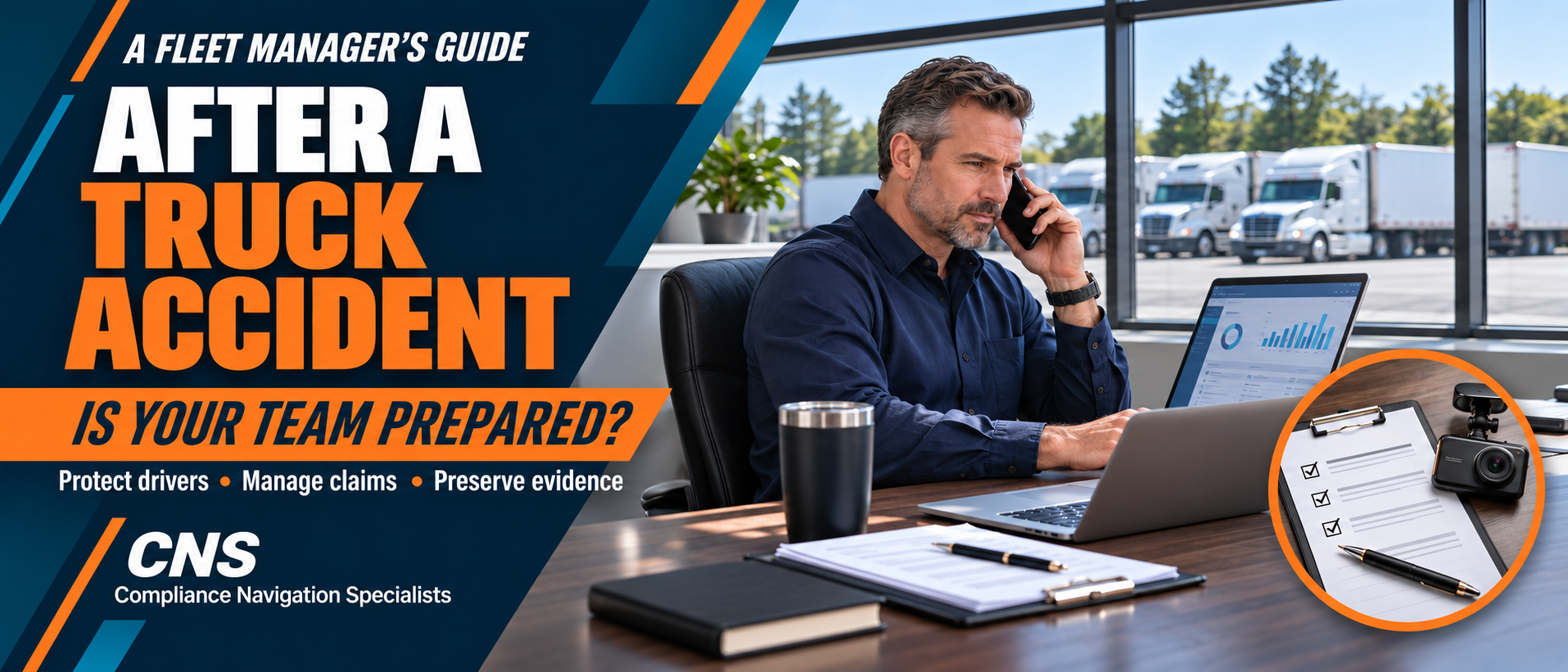
A serious crash tests more than your driver’s response. It tests your company’s communication, documentation, safety practices, and ability to make sound decisions under pressure.
The call comes from a driver who sounds shaken. There has been a collision. Someone may be seriously injured. Police are responding, traffic is backing up, and your driver wants to know what to do.
As a fleet manager, you need to support that driver while coordinating several responsibilities at once: emergency response, required testing, insurance notification, evidence preservation, equipment recovery, and continued operations.
The situation may also lead to a lawsuit involving your driver and company. When that happens, the investigation can reach well beyond the crash itself into hiring decisions, maintenance records, dispatch instructions, training, and how your company handled earlier warning signs.
An organized response helps protect people, establish an accurate record, and avoid creating additional problems after an already serious event.
Here is what fleet managers should consider at each stage.
1. Take control of the response and support the driver
Your first conversation should establish what help is needed. A frightened or injured driver may struggle to follow a long checklist.
Start with direct questions:
- Where are you, and what is your callback number?
- Are you injured? Is anyone else injured or trapped?
- Has someone called 911?
- Are vehicles blocking traffic?
- Is there fire, spilled fuel, hazardous cargo, or another immediate danger?
- Are you in a safe location?
Confirm that emergency responders have been contacted. Remind the driver to activate hazard lights and deploy warning devices according to their training when physically able and safe to do so. Do not ask them to walk into traffic, collect debris, or take photographs before addressing immediate danger.
Assign one person to coordinate the company’s response. In a small fleet, that may be the owner. In a larger operation, it may be a safety or claims manager.
Other employees can handle separate tasks, but the driver should not receive conflicting instructions from dispatch, maintenance, management, and the insurance agent.
Give the driver a clear next step and a dependable contact:
“Emergency help is coming. Focus on your safety and follow responders’ instructions. I am coordinating the company response and will help arrange testing, transportation, and the next steps.”
Fleet manager tip: Do not make delivery status your first concern. Arrange customer communication and replacement capacity separately so the driver can focus on the emergency.
2. Open an incident file and separate facts from assumptions
Create a central incident file with a unique reference number. Record the crash location, reported time, involved driver and equipment, responding agency, injuries as currently known, and initial actions taken.
Distinguish between confirmed information and preliminary reports.
“Driver reports that another vehicle entered the lane” accurately identifies the source. “Other driver caused the crash” reaches a conclusion before the investigation is complete.
Build a running action log that identifies:
- What was reported and by whom.
- Who received each notification.
- Which tasks were assigned.
- What remains unresolved.
- When new information changed a decision.
Preserve original driver notes and statements. If someone corrects an error or provides additional information, retain the original and document the correction.
Avoid having several managers independently interview the driver. Repeated questioning can create unnecessary confusion and inconsistent summaries. Coordinate a factual account when the driver is able, with counsel’s guidance when appropriate.
Do not coach the driver toward a preferred version of events. Your goal is an accurate record, including facts that may be difficult for the company.
3. Activate insurance and legal resources promptly
Notify the appropriate insurer or claims administrator under the policy’s requirements. Do not wait for a police report, a final fault determination, or a demand letter.
Provide available facts, explain what remains uncertain, and supplement the report as information develops.
For a serious injury or fatality, ask the claims team whether defense counsel, an investigator, or a crash reconstruction specialist should be engaged immediately.
Confirm who is responsible for:
- Investigating the claim.
- Communicating with other parties.
- Coordinating vehicle inspections.
- Preserving electronic and physical evidence.
- Monitoring legal deadlines.
- Evaluating coverage and settlement decisions.
Depending on the incident, commercial auto liability, physical damage, cargo, workers’ compensation, excess liability, or environmental coverage may require attention. Ask your agent or claims team which policies and parties need notice.
Do not assume notifying your agent automatically satisfies every policy’s notice requirements. Obtain confirmation that the claim was received and identify the assigned contact.
Fleet manager tip: Keep primary and backup claims contacts available after hours. A contact list that only works during office hours leaves a predictable gap.
4. Make separate decisions about recordability, testing, and other reporting
One crash can trigger several different obligations. A single “DOT accident: yes or no” checkbox is not enough.
Evaluate separately:
- Does the event meet the applicable federal accident definition?
- Is DOT post-accident drug or alcohol testing required?
- Are state crash reports or other notifications required?
- Does a hazardous materials release trigger additional reporting?
- What do company policy and insurance contracts require?
The federal accident definition generally covers a qualifying CMV crash involving a fatality, an injury requiring immediate medical treatment away from the scene, or disabling damage requiring a vehicle to be transported away. Recordability does not establish fault.
For qualifying accidents, carriers must maintain an accident register for three years after each accident. Required information includes the date, location, driver’s name, injury and fatality counts, and whether qualifying hazardous materials were released. The rule also requires retention of accident reports required by governmental entities or insurers.
Assign someone to update the file if injuries, citations, or other facts change.
Fleet manager tip: Document why a crash was classified a particular way. “No test required” should be supported by the actual circumstances and applicable rule.
5. Manage post-accident testing as an assigned responsibility
Do not leave a shaken driver to locate an open collection site without support.
For covered drivers and operations, federal post-accident testing generally follows these conditions:
| Circumstances | Federal DOT testing trigger |
| Human fatality | Testing required for the surviving covered driver regardless of citation, subject to the applicable testing windows. |
| Injury requiring immediate medical treatment away from the scene | A qualifying moving-violation citation issued to the CMV driver within the applicable window. |
| Disabling damage requiring an involved vehicle to be transported away | A qualifying moving-violation citation issued to the CMV driver within the applicable window. |
The citation windows are eight hours for alcohol and 32 hours for controlled substances. Testing must occur as soon as practicable.
Assign a knowledgeable employee to arrange collection, verify site availability and test type, coordinate transportation, and document attempts and completion.
If required alcohol testing has not occurred within two hours, document the reason. Stop attempts at eight hours for alcohol and 32 hours for controlled substances, with the required explanation. Necessary emergency medical treatment must not be delayed.
Continue monitoring citation status within the applicable windows. A citation issued later can change the testing decision.
Keep DOT tests distinct from any separately authorized company-policy testing. Do not assume emergency-room bloodwork or a police test automatically satisfies the employer’s DOT obligation; qualifying law-enforcement testing has specific conditions.
What not to do: Apply “test everyone after every accident” as a DOT rule. Broader company testing requires a separate policy and consideration of applicable law.
6. Preserve evidence before routine systems overwrite it
A camera system can contain decisive evidence and still fail the company if nobody preserves the recording.
Contact counsel promptly to determine preservation obligations and the appropriate scope of a litigation hold. Serious injury or fatality crashes warrant immediate attention; a formal demand letter is not the only event that can trigger preservation duties.
Potential evidence includes:
| Evidence category | Examples to identify and preserve |
| Video | Forward and inward cameras, side views, event clips, surrounding footage, relevant third-party recordings. |
| Operational data | ELD records and edit history, GPS, telematics, dispatch messages, route assignments. |
| Driver records | Qualification documents, relevant training, coaching, prior events, testing records. |
| Equipment records | Inspection reports, defect notices, work orders, maintenance history, electronic vehicle data. |
| Trip records | Bills of lading, fuel receipts, tolls, load information, scale tickets, customer instructions. |
| Communications | Relevant emails, texts, messaging apps, call records, and communications on personal devices used for work. |
Preserve originals, metadata, and usable export formats where available. A screenshot may help someone review a record, but it may not preserve everything contained in the underlying system.
Notify relevant vendors and obtain confirmation that preservation occurred. Do not assume your instruction to an employee automatically stops deletion by a camera provider or dispatch platform.
Maintain a record of what was collected, who collected it, and where it is stored. Verify files can be opened without changing the originals.
Courts can impose remedies for lost evidence. Federal Rule 37(e) addresses electronic information that should have been preserved, with different consequences depending on prejudice and intent; state law may differ.
Fleet manager tip: Assign a named evidence coordinator and require confirmation of completed preservation. Sending an email is the beginning of the task.
7. Treat the truck, trailer, and cargo as potential evidence
Equipment recovery creates operational pressure. Storage fees accumulate, cargo may be time-sensitive, and replacement equipment may be limited.
Those pressures need management, but repairs or disposal can destroy evidence.
Confirm:
- Who has custody of the tractor, trailer, and cargo.
- Where each item is located.
- Whether police have imposed a hold.
- Who controls access.
- Which inspections and data downloads are needed.
- Who can authorize repairs, release, salvage, or disposal.
Coordinate with counsel, the insurer, recovery providers, and qualified experts. When appropriate, counsel can arrange notice and inspection opportunities for other interested parties.
Tell vendors that non-emergency repairs, component disposal, data clearing, and salvage require authorization. Preserve damaged components when directed.
Emergency actions needed to protect life, control a spill, or comply with responders’ instructions should proceed. Document what changed and why.
Fleet manager tip: Keep recovery-cost discussions and evidence decisions coordinated. A storage invoice should not quietly become authorization to repair or scrap the truck.
8. Control communications while treating people with care
Designate a spokesperson for media and public inquiries. Give employees a simple instruction to refer questions to that person and avoid speculation.
Internal updates should also stay factual. Avoid broad emails assigning fault, criticizing the driver, or predicting lawsuit outcomes.
Statements such as “We knew this would happen” can be damaging when unsupported or stripped of context. If there was a known problem, report it accurately to the appropriate people and counsel. Do not hide it or substitute vague language.
Coordinate any outreach to injured people or families with the claims team and counsel. A designated representative may be able to express concern and offer an appropriate contact without debating liability or making unauthorized promises.
Do not allow multiple managers to contact the family independently. Avoid requests for releases, admissions, or quick settlements outside the authorized claims process.
Employees should preserve relevant social media material and avoid discussing the crash online. If something has already been posted, seek guidance rather than ordering deletion.
What not to do: Publicly accuse another motorist of fraud or staging a crash. Preserve specific evidence and report concerns to investigators and claims professionals.
9. Understand who counsel represents and how confidentiality works
A company attorney does not automatically represent the driver personally. Clarify whether counsel represents the carrier, the driver, or both, and how potential conflicts will be handled.
This becomes especially important when there are possible criminal charges, coverage questions, or competing accounts of company instructions.
Ask counsel to explain how to handle legal communications, investigation materials, and expert involvement.
Do not assume that copying an attorney or labeling a document “privileged” makes ordinary business records confidential. Privilege and work-product protection depend on the circumstances and governing law. Broad distribution can also create waiver issues.
Continue required reporting, recordkeeping, and safety work. Legal coordination should support those responsibilities.
Fleet manager tip: Establish the investigation process with counsel before a serious crash. Deciding who directs which work is easier without an emergency underway.
10. Investigate company decisions as carefully as driver actions
A useful investigation asks how the collision happened and what conditions contributed.
Review the driver’s actions, but also examine the operation around them:
- Was the schedule realistic for legal hours and conditions?
- Had the driver reported fatigue, illness, or equipment problems?
- Did dispatch respond appropriately?
- Were relevant camera alerts reviewed and addressed?
- Did the driver receive training suited to the assignment?
- Were recurring defects repaired and verified?
- Was the route appropriate for the vehicle and load?
- Did incentives encourage unsafe shortcuts?
For example, a missed following-distance opportunity may require driver coaching. If dispatch also expected an impossible arrival time and ignored a request to stop, the corrective action must reach dispatch and planning.
Preserve records as they existed. Do not backdate training, rewrite old policies, or replace incomplete forms with documents that appear to have been created earlier.
Correct genuine record errors transparently, retaining the original and explaining the correction.
Keep company preventability reviews, regulatory determinations, and legal liability distinct. Each serves a different purpose.
Fleet manager tip: Every corrective action needs an owner, completion date, and verification. “Driver counseled” rarely explains what was taught or whether performance improved.
11. Prepare for discovery and testimony
If litigation follows, discovery may require documents, written responses, and sworn testimony. Cases can also resolve through settlement or court rulings before trial.
The requests may reach beyond the involved driver to relevant company policies, supervision, maintenance practices, training, and management decisions.
Organize records so counsel can locate and evaluate them. Identify the people who know how systems actually operated, including former employees and outside vendors when relevant.
Forward legal papers immediately. Record receipt dates and route summonses, subpoenas, preservation demands, and settlement demands to counsel and claims personnel. Some demands have significant deadlines and conditions; do not leave them in a general inbox.
Managers and drivers should prepare for testimony with counsel. Preparation should develop accurate understanding of records and events. Never coordinate false accounts or ask employees to conceal unfavorable facts.
If the company must designate a corporate representative, work with counsel to select and prepare someone for the specified subjects. That preparation may require reviewing information beyond the individual’s personal involvement.
Fleet manager tip: Maintain continuity when staff change. A lawsuit may remain active long after the safety manager, dispatcher, or driver leaves.
12. Manage the claim as an ongoing business responsibility
Once immediate needs are addressed, establish regular claim reviews with the insurer and counsel.
Discuss:
- Investigation findings and remaining questions.
- Coverage issues and applicable deductibles or retentions.
- Upcoming deadlines and decisions.
- Defense expenses and reserve changes.
- Settlement discussions and who has authority.
- Excess-carrier notification and coordination.
- Operational actions that could affect evidence or the claim.
Do not make a private payment, promise coverage, or sign a release without appropriate authorization.
Track recovery, storage, cargo, replacement equipment, and other losses with supporting records. Separate confirmed expenses from estimates.
If you disagree with a claims decision, raise the issue through the established process and document the discussion.
Fleet manager tip: Assign a backup who can act when the primary contact is unavailable. Important legal correspondence should never depend on one person checking email during vacation.
13. Support recovery and make a deliberate return-to-work decision
The driver may need medical care, transportation, lodging, help contacting family, or assistance navigating a work-related injury claim.
Explain reporting procedures, available benefits, work restrictions, and who will maintain contact. Limit sensitive health information to people who need it.
A driver who is medically released may still need further evaluation of driving readiness, restrictions, medication effects, or applicable qualification requirements. Federal rules prohibit operation when fatigue, illness, or another cause makes driving unsafe.
Coordinate a return-to-work plan that may include temporary duties, relevant refresher training, and an evaluation by a qualified person.
Apply employment policies consistently. Avoid making an immediate disciplinary decision simply to demonstrate that the company “did something.” Base decisions on established facts, safety needs, policy, and appropriate HR and legal advice.
Fleet manager tip: Schedule follow-up contact after the initial response ends. The driver’s needs may continue while management attention shifts back to operations.
14. Review the crash record and close the safety gaps
Check applicable crash and inspection records for accuracy. Use the appropriate correction process when supported by evidence.
For eligible events, consider FMCSA’s Crash Preventability Determination Program through DataQs. Supporting materials include the police accident report and relevant documentation, photographs, or video. A not-preventable determination affects treatment in federal safety systems; it does not establish civil fault or legal liability.
Then assess how the company’s response performed:
- Could the driver reach someone immediately?
- Were instructions clear and consistent?
- Was testing evaluated and arranged correctly?
- Was footage preserved before deletion?
- Did vendors understand preservation instructions?
- Were insurance and legal resources activated appropriately?
- Did the driver receive needed support?
Use those findings to improve training, contacts, vendor arrangements, and procedures.
Practice the revised process with a realistic scenario. A policy sitting in a folder does not demonstrate that the night dispatcher can use it.
Build the response before the next call
A fleet’s accident-response plan should identify who leads, who acts as backup, what drivers are trained to do, and how the company accesses testing, claims assistance, counsel, recovery providers, and evidence systems after hours.
The same preparation should extend to everyday operations. Maintain accurate qualification files. Resolve reported defects. Review relevant camera events. Plan schedules drivers can complete safely. Document training and verify that corrective actions work.
A well-run program cannot guarantee that a crash or lawsuit will never happen. It gives the company a stronger basis for responding accurately, caring for people, and explaining its decisions.
How CNS can help fleets prepare
Compliance Navigation Specialists helps fleets strengthen the safety and compliance practices that matter before and after a serious collision, including driver qualification files, hours-of-service compliance, training, maintenance documentation, mock DOT audits, and drug and alcohol program administration.
CNS can help identify gaps in your procedures and prepare managers and drivers to carry out their responsibilities alongside your insurer and legal counsel.
Contact CNS to review your accident-response procedures and build a safety program your team can put into practice when a serious crash occurs. Call us at 888.260.9448 or email info@cnsprotects.com.
This guide provides general safety and compliance information. Requirements vary by operation and jurisdiction. Work with qualified counsel, your insurer, and appropriate compliance professionals on a specific incident.
Truck Accident FAQs for Fleet Managers
1. What should a fleet manager do immediately after a truck accident?
Confirm the driver’s location, check for injuries, and make sure emergency responders have been contacted. Assign one company contact to coordinate the response. Next, notify the insurer, evaluate post-accident testing requirements, preserve evidence, and document actions in a central incident file. Driver safety and emergency care come first.
2. What makes a truck accident DOT-recordable?
A qualifying commercial motor vehicle crash generally becomes DOT-recordable when it involves a fatality, an injury requiring immediate medical treatment away from the scene, or disabling damage requiring a vehicle to be transported away. Recordability does not determine fault, and a recordable accident does not automatically require DOT drug and alcohol testing.
3. When is DOT post-accident drug and alcohol testing required?
For drivers and operations covered by FMCSA testing rules, a fatal crash requires testing of the surviving covered driver regardless of whether a citation is issued. For a nonfatal crash involving qualifying injuries or disabling damage, testing depends on the CMV driver receiving a moving-violation citation arising from the crash within eight hours for alcohol or 32 hours for drugs.
4. What are the time limits for DOT post-accident testing?
Required testing must happen as soon as practicable. If an alcohol test is not completed within two hours, document the delay. Stop alcohol-testing attempts after eight hours and drug-testing attempts after 32 hours, documenting why testing was not completed. These deadlines run from the accident, and necessary emergency medical care must not be delayed.
5. How long must trucking companies keep a DOT accident register?
Motor carriers must retain an accident register for three years after each qualifying accident. Entries must include the accident date, location, driver’s name, injury and fatality counts, and whether qualifying hazardous materials were released. Carriers must also retain accident reports required by government agencies or insurers.
6. What evidence should a trucking company preserve after an accident?
Preserve relevant dashcam footage, ELD records, GPS and telematics data, dispatch communications, driver qualification and training records, maintenance documents, and trip records. The truck, trailer, damaged components, and cargo may also contain evidence. Coordinate with counsel and vendors promptly to prevent automatic deletion, overwritten recordings, or repairs that could destroy information.
7. When should a trucking company report an accident to its insurance company?
Notify the appropriate insurer or claims administrator promptly, following the policy’s reporting requirements. Do not wait for a completed police report or a final decision about fault. Share confirmed facts, identify uncertainties, and verify that the claim was received. Ask whether cargo, workers’ compensation, excess liability, or other coverage also requires notification.
8. Can a truck be repaired after an accident while a claim is pending?
Coordinate non-emergency repairs with the insurer and counsel before authorizing work. The vehicle may need inspections, electronic data downloads, or preservation of damaged parts. Confirm who can approve repairs, salvage, or disposal. Emergency actions needed to protect people or control hazards should proceed, with documentation of what changed and why.
9. How can a fleet prepare for a truck accident lawsuit?
Organize relevant records, preserve original evidence, and forward legal notices and demands promptly to counsel and claims personnel. Review company decisions involving hiring, training, dispatch, supervision, and maintenance alongside the driver’s actions. Prepare employees to provide accurate information, and never backdate records, alter evidence, or coordinate false accounts.
10. What should a fleet accident-response plan include?
A fleet accident-response plan should identify a response leader and backup, emergency procedures, after-hours claims contacts, testing arrangements, evidence-preservation responsibilities, and equipment-recovery procedures. It should also address driver support, internal communication, and follow-up reviews. Train drivers and managers on their responsibilities and practice the plan before a serious crash occurs.

Luke Kibby
Questions about DOT Compliance, Licensing, Audits, Programs, etc.?
Our DOT Specialists are here to help!
Is DOT Compliance your Top Priority?
Our DOT Compliance Programs ensure it is your top priority and keeps your business running.
Related Services
Related news
Trucking News
Get the latest trucking news on DOT Compliance, Licensing, Audits, and more!
Top 5 FMCSA Rulemaking Announcements to Watch Before the End of 2026
What could change for trucking businesses and how fleets can prepare heading into 2027 The final weeks of 2026 could bring movement on several FMCSA

Oregon Weight-Mile Tax Changes: Is Your Fleet Ready for July 2027?
If your trucks travel through Oregon, upcoming tax changes deserve a place on your compliance calendar. Beginning July 1, 2027, Oregon will simplify its weight-mile

$1.5 Billion Delaware River Port Expansion: Is Your Fleet Ready for the Opportunity?
Two major investments at Philadelphia and Wilmington could create new work for construction haulers, drayage carriers, auto transporters, and the businesses supporting them. Taking advantage
