
$1.5 Billion Delaware River Port Expansion: Is Your Fleet Ready for the Opportunity?
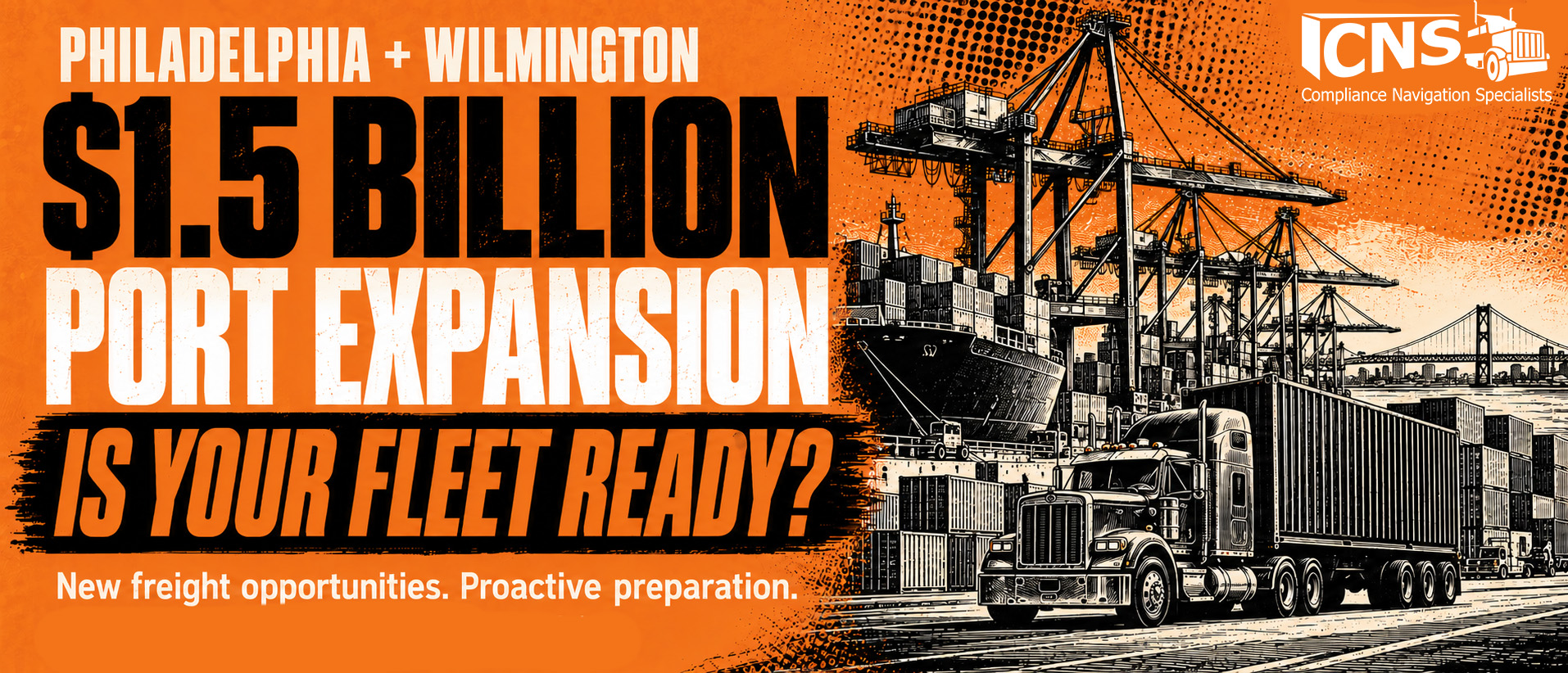
Two major investments at Philadelphia and Wilmington could create new work for construction haulers, drayage carriers, auto transporters, and the businesses supporting them. Taking advantage starts with preparing your drivers, equipment, insurance, and compliance program.
More than $1.5 billion in announced port development is moving forward along the Delaware River, putting a major transportation opportunity within reach of Pennsylvania, Delaware, New Jersey, and surrounding states.
Philadelphia’s approximately $837 million expansion and Wilmington’s $669 million Delaware Container Terminal project could generate demand well beyond the waterfront.
- Construction requires materials and equipment.
- Expanded terminals create opportunities to move containers and vehicles.
- Warehouses and distribution operations need transportation partners that can handle the freight safely and reliably.
For fleets, the opportunity starts before the new berths open. Now is the time to determine which work fits your business and whether your operation is ready to qualify for it.
What is changing at Philadelphia and Wilmington
On October 13, 2026, Governor Josh Shapiro announced a PhilaPort investment package combining $371.5 million in state capital funding, $266 million in federal support, and at least $200 million in private investment. The plan projects a 122% increase in container capacity, an 18% increase in auto capacity, and more than 6,000 new jobs.
Projects include a new 2,000-foot berth at Southport Marine Terminal, acquisition of the 152-acre Mustin Yard for auto and container expansion, and $58.1 million for cranes and equipment. Improvements at Tioga Marine Terminal will support liquid bulk barges and breakbulk vessels.
In Wilmington, Enstructure and the Diamond State Port Corporation celebrated groundbreaking for the Delaware Container Terminal at the former Edgemoor industrial site on September 14, 2026. The $669 million project targets an early 2029 opening. At full development, its planned annual capacity is 1.2 million twenty-foot equivalent units, or TEUs, a standard container measurement.
These are development plans and capacity projections. Actual trucking demand will depend on construction progress, customer commitments, cargo volumes, and how freight moves between trucks and rail.
Fleets should follow procurement notices and terminal announcements as projects advance.
Where transportation opportunities could develop
The first wave is construction. Site preparation, dredging support, reclamation, and berth development can require dump trucks, lowboys, equipment transporters, and material deliveries. A contractor’s own trucks may also fall under DOT rules when used on public roads.
As capacity comes online, opportunities could expand into:
- Container drayage between terminals, rail facilities, warehouses, and distribution centers.
- Auto transport serving expanded vehicle-handling operations.
- Flatbed and specialized hauling for steel, machinery, and project cargo.
- Refrigerated transportation supporting perishable imports and cold storage.
- Regional distribution and freight brokerage connecting port cargo with inland customers.
Tioga illustrates the range of work already supported by the river’s terminals. Operated by Delaware River Stevedores, its 116-acre facility handles steel, forest products, containers, oversized freight, and project cargo, with dry and cold storage and connections to CSX and Norfolk Southern.
The practical question is which of these services your fleet can deliver profitably while meeting the customer’s requirements.
Confirm your DOT obligations before bidding
Being a construction company does not automatically place your trucks outside motor carrier regulations. A business hauling its own equipment or materials may be a private motor carrier, even if transportation is not its primary service.
Review vehicle and combination weights, cargo, routes, and whether transportation is interstate or intrastate. Federal USDOT registration can apply to interstate property transportation at 10,001 pounds or more under the applicable weight definitions. State requirements may also apply. The threshold for DOT regulation is different from the threshold for requiring a CDL.
A short local trip can also remain part of interstate or foreign commerce. Moving an imported container from a Philadelphia terminal to a Pennsylvania warehouse does not automatically make the trip intrastate; the shipment’s intended movement matters.
Before accepting work, confirm your registration, whether operating authority is required or an exemption applies, and the driver qualification, maintenance, and safety obligations attached to your operation.
Build a hiring process that can keep up with growth
Hiring quickly creates problems when qualification checks happen after dispatch. Establish a process that confirms the appropriate license, endorsements, restrictions, medical qualification, and required driver qualification file documentation before assigning a driver.
For CDL drivers covered by FMCSA drug and alcohol testing rules, employers must complete the required pre-employment Clearinghouse query and continue annual queries. A verified negative pre-employment controlled substances test is generally required before safety-sensitive work, unless a regulatory exception applies. Required random testing and other program responsibilities continue after hiring.
A general employment drug screen does not substitute for the required DOT testing process.
Training should also match the assignment. A new CDL holder may need additional instruction in terminal traffic, backing, chassis coupling, container securement, or car-hauler loading before working independently.
Plan for terminal access and delays
Drivers who need unescorted access to secure areas of regulated maritime facilities generally need a Transportation Worker Identification Credential, or TWIC. Confirm the specific terminal’s access procedures before scheduling the first pickup. A TWIC does not replace terminal authorization, appointments, or other onboarding requirements.
Gate delays also affect hours of service. Local drayage does not automatically qualify for the short-haul exception. The standard 150-air-mile exception includes returning to the normal reporting location and being released within 14 consecutive hours, along with other conditions and required time records retained for six months.
Fleets should establish how dispatch will respond when a driver no longer meets the exception and logging or ELD requirements apply. Do not assume waiting time at a terminal is off duty simply because the truck is stationary.
Inspect chassis and prepare for specialized loads
Using someone else’s chassis does not eliminate driver inspection responsibilities. FMCSA requires drivers to assess specified intermodal equipment components and report identified damage, defects, or deficiencies to the equipment provider. Those components include visible brake equipment, tires, lights, coupling devices, and locking mechanisms.
Build time into dispatch for inspections and defect resolution. A pickup appointment should never pressure a driver into accepting unsafe equipment.
Match securement training to the freight. Containers, vehicles, heavy equipment, and other commodities can have different requirements. Oversized or overweight movements also require a route and permit review before dispatch; proximity to a port does not remove highway, bridge, axle-weight, or clearance restrictions.
For multistate operations, review apportioned registration, fuel-tax credentials, UCR, titles, and trip permits as applicable to the vehicle and operation. Confirm requirements with each relevant jurisdiction rather than assuming one credential covers every movement.
Review insurance before changing your operation
Adding auto hauling, intermodal work, refrigerated cargo, or construction equipment transport can change your exposure. Ask your insurance team to review the actual work, cargo values, contracts, operating territory, and use of borrowed or interchanged equipment before you accept a load.
A certificate of insurance alone does not establish that every activity or contractual obligation is covered. Compare policy terms with customer requirements and identify exclusions, limits, and endorsements that could affect the work.
Employers working at ports should also evaluate whether the Longshore and Harbor Workers’ Compensation Act applies. Coverage depends on factors including the employee’s duties and work location; certain maritime and harbor construction workers may fall within the federal program. Do not assume state workers’ compensation coverage resolves every waterfront exposure.
Prepare for worker health and injury prevention
Port growth also brings hiring and safety demands for construction companies, terminals, warehouses, and distribution employers. Planning should address job demands, traffic and pedestrian separation, lifting, equipment operation, injury response, and exposure-specific requirements.
Depending on the job, employers may need DOT physicals, appropriate employment testing, post-offer evaluations tied to essential job functions, or occupational health services. Noise, respiratory, and other hazards should be evaluated against the standards applicable to the work.
Pennsylvania employers should also consider a state-certified workplace safety committee. Qualifying employers can earn an annual 5% workers’ compensation premium discount by meeting certification and ongoing program requirements. Completing safety committee training alone does not qualify the employer for the discount.
How CNS helps businesses prepare for port growth
CNS Companies can help fleets and contractors connect transportation growth with the safety and systems needed to support it.
This includes:
- DOT compliance reviews
- New carrier setup
- Driver qualification files
- Drug and alcohol programs
- Audit preparation
- Safety training
- CDL school training
- Commercial insurance
- Driver and employee health through physicals, testing, injury care, and occupational health services
- Vehicle titles, registrations, and applicable permitting needs
For employers coordinating workers’ compensation, occupational health, and safety, CNS’s Comp360 approach brings those services together around injury prevention and risk management.
Whether you are pursuing construction contracts now or preparing for future port freight, start with a review of your operation. Identify the work you want, the requirements attached to it, and the gaps that could delay your first assignment.
Need help? Fill out the form below to contact CNS.

Luke Kibby
Questions about DOT Compliance, Licensing, Audits, Programs, etc.?
Our DOT Specialists are here to help!
Is DOT Compliance your Top Priority?
Our DOT Compliance Programs ensure it is your top priority and keeps your business running.
Related Services
Related news
Trucking News
Get the latest trucking news on DOT Compliance, Licensing, Audits, and more!

Oregon Weight-Mile Tax Changes: Is Your Fleet Ready for July 2027?
If your trucks travel through Oregon, upcoming tax changes deserve a place on your compliance calendar. Beginning July 1, 2027, Oregon will simplify its weight-mile
How Freight Brokers Can Vet Motor Carriers and Build a Defensible Carrier Selection Process
Choosing a motor carrier is no longer just a capacity decision. It is a risk-management decision that could later be examined by a shipper, insurer,

In-House vs. Outsourced DOT Compliance: What Is Right for a Growing Fleet?
A fleet rarely outgrows its safety department overnight and the warning signs usually appear one at a time. Does this sound like you? A safety
