
ELD Management
Log auditing made easy
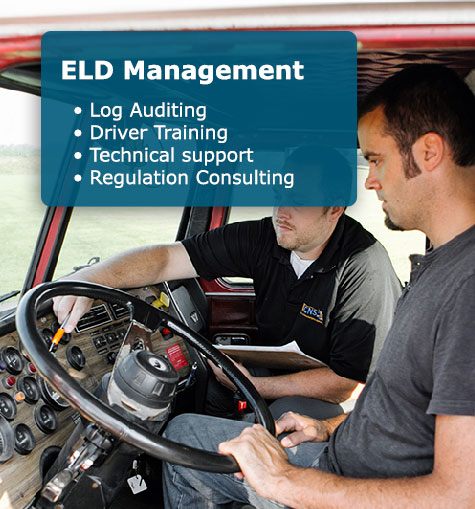
Allow our ELD Specialists to manage the logs for all of your drivers. ELD Management consists of log auditing, ELD training, and consulting.
What is the FMCSA Regulation for ELDs?
§395 (a-c) Subpart B Appendix A
The ELD is an electronic module capable of recording the electronic records of duty status for CMV drivers using the unit in a driving environment within a CMV and meets the compliance requirements in this appendix. The below sections discuss who would use an ELD.
CMV drivers employed by a motor carrier are required to use an ELD
Support personnel who have been authorized by the motor carrier to:
(1) Create, remove, and manage user accounts
(2) Configure allowed ELD parameters; and
(3) Access, review, and manage drivers’ ELD records on behalf of the motor carrier.
Who does it apply to?
All CMV drivers falling into a certain category are required to use an ELD. If you must use one, you may benefit from training or allowing our ELD Specialists manage your logs.
How do we perform this service?
We manage all ELD Systems
Our team of ELD Specialists can help you with your new Pedigree OneView ELD System or whichever ELD System you are currently using. There are a number of ELDs to choose from depending on what you need, however we find Pedigree ELDs to be the most reliable.
What steps are we taking for you?
- Audit the E-Logs and Paper logs
- Email template for drivers to use to make change or corrections
- Review and assign unidentified records
- Account Manager assigned to your account to make recommendations for drivers who need further training
- Train drivers with repeat violations
- Create reports for each driver tracking their violation
- Encourage improvement by having drivers sign violation reports that we create
- Provide consulting hours-of-service
- Offer phone support for drivers to fix errors on their logs
- Engage with your ELD provider on your behalf for ELD issues
DOT Compliance and Licensing Services
Only need a few PSM® services?
Check out our Custom PSM® Program
Bundle the services that matter most to your operation
—without paying for each one a la carte.
DVIR and Vehicle Inspection FAQs
A Driver Vehicle Inspection Report, or DVIR, is a written or electronic report completed by a driver to document vehicle defects or deficiencies. The purpose is to help ensure unsafe equipment is identified, repaired, and not dispatched before it is safe to operate.
Under federal rules, drivers are required to complete a DVIR at the end of the day when operating certain commercial motor vehicles. However, FMCSA removed the federal requirement for most property-carrying CMV drivers to submit and carriers to retain “no-defect” DVIRs when no defects or deficiencies are found or reported. Passenger-carrying CMVs are treated differently and still have stricter DVIR requirements.
Even when a no-defect DVIR is not federally required, many carriers still choose to require daily DVIRs as a safety and documentation best practice.
A DVIR should identify the vehicle, list any defects or deficiencies discovered or reported, and note issues that could affect safe operation or cause a mechanical breakdown. The driver must sign the report when a report is required. The carrier must then address defects that affect safety before the vehicle is operated again.
Under current federal rules, a DVIR does not generally have to be kept inside the vehicle. However, if the vehicle travels into Canada, Canadian rules may require the DVIR to be carried in the vehicle.
Because rules can vary by operation and jurisdiction, carriers should confirm requirements for the states, provinces, and types of operations they run.
Yes. Before operating the vehicle, the driver must be satisfied that the vehicle is in safe operating condition. If the previous DVIR noted defects, the driver should confirm that the required repairs were completed or that the defect does not affect safe operation before driving.
The driver should report the defect according to company procedure. If the defect affects safe operation, the vehicle should not be operated until the issue is corrected or properly addressed.
A strong DVIR process should clearly answer these questions:
Who receives the defect report?
Who decides whether the vehicle can be operated?
Who documents the repair?
Who confirms the vehicle is safe before dispatch?
When a DVIR is required, motor carriers generally must retain the report and related repair certification records for 3 months. FMCSA guidance also notes that if the back of a daily log is used as the DVIR, the retention requirements for both the DVIR and the record of duty status must be met.
DVIRs help show that the company has a working inspection, repair, and maintenance process. Incomplete DVIRs, ignored defects, missing repair documentation, or drivers operating unsafe equipment can create serious compliance, safety, and insurance concerns.
A good DVIR process protects the driver, the company, and the public by showing that vehicle problems are identified, communicated, repaired, and documented before they lead to a roadside violation, crash, or audit issue.
