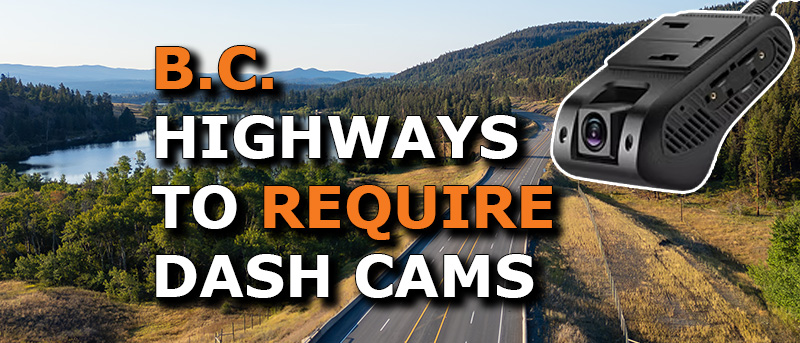
British Columbia is on track to become the first jurisdiction in Canada to require dash cameras in commercial vehicles, creating a new compliance obligation that could impact fleets on both sides of the border.
The province’s Dashboard Cameras in Commercial Vehicles Act (Bill M217) recently passed unanimously through the B.C. Legislature and will take effect once signed by the province’s lieutenant-governor, putting the likely compliance date in late 2026 or early 2027.
The legislation requires qualifying commercial vehicles operating on B.C. highways to be equipped with forward-facing dash cameras that continuously record while the vehicle is in operation.
For any fleet that regularly travels through British Columbia, now is the time to evaluate your camera technology and implementation strategy.
What Does the New Law Require?
Under Bill M217, commercial vehicles with a gross vehicle weight rating (GVWR) greater than 11,793 kg (approximately 26,000 pounds) must be equipped with a dashboard camera that:
- Continuously records while the vehicle is operating
- Captures the roadway ahead through the windshield
- Records in at least 1080p high-definition video
- Includes night vision capability
- Retains at least 72 hours of footage
- Remains unobstructed and operational during vehicle operation
Importantly, the legislation only requires outward-facing cameras. Driver-facing cameras are not mandated under the law.
Which Fleets Will Be Affected?
Canadian Fleets Operating in British Columbia
Any carrier operating heavy commercial vehicles on B.C. highways will likely need to comply once the law takes effect. This includes:
- Long-haul trucking companies
- Regional freight carriers
- Bulk transportation fleets
- Construction and heavy equipment transport operations
- Bus and passenger transportation companies that fall under the province’s commercial vehicle definitions
This regulation is on top of the 2024 regulations requiring speed-limiters for commercial trucks along with stiffer penalties for drivers who hit overpasses.
B.C. Trucking Association’ president, Dave Earle, said three-quarters of his group’s members are already equipped with the technology.
U.S. Fleets Crossing Into British Columbia
Many U.S. carriers may be surprised to learn they could also be impacted.
The legislation applies to qualifying commercial vehicles operating on B.C. highways, regardless of where the vehicle is registered. That means fleets based in Washington, Idaho, Montana, or elsewhere in the United States that regularly haul freight into British Columbia could be subject to the requirement.
Carriers serving Alaska via the Alaska Highway should pay particularly close attention, as nearly all overland routes to Alaska pass through British Columbia.
Fleets Already Using Dash Cameras
Many carriers have already adopted dash camera technology to protect drivers and reduce liability. However, existing systems should be evaluated to ensure they meet the specific requirements outlined in the legislation, particularly regarding video retention, resolution, and night-vision capabilities.
More Than Compliance: Choosing the Right Dash Camera Solution
As fleets prepare for evolving safety requirements, simply installing a basic camera may not provide the full value modern operations need.
That’s where solutions like Pedigree Technologies’ CameraView system can help.
CameraView is an AI-powered, plug-and-play camera solution that integrates with Pedigree Technologies’ OneView fleet management platform, providing fleets with more than just video footage.
Key capabilities include:
- Forward-facing dash camera technology
- AI-powered event detection
- Video-based safety monitoring
- Integrated fleet visibility through the OneView platform
- Simplified deployment and management
- Real-time access to critical vehicle and driver data
Rather than treating dash cameras as a standalone compliance requirement, fleets can leverage camera technology as part of a broader safety, risk management, and operational efficiency strategy.
What Should Fleets Do Now?
Although enforcement details and final regulations are still being developed, fleets that operate in British Columbia should begin preparing now.
Recommended next steps include:
- Identify vehicles that operate in British Columbia.
- Inventory existing dash camera technology.
- Verify whether current systems meet anticipated technical requirements.
- Update driver policies and pre-trip inspection procedures.
- Evaluate camera solutions that provide both compliance support and operational value.
Could This Be the Start of a Larger Trend?
One of the biggest concerns raised by industry stakeholders is the potential for a patchwork of provincial regulations. The B.C. Trucking Association has already called for a national approach to avoid differing requirements across provinces.
Whether other provinces follow British Columbia’s lead remains to be seen, but the trend is clear: regulators and carriers increasingly view dash camera technology as a valuable tool for improving highway safety and protecting professional drivers.
For fleets, investing in the right camera technology today may not only help address future compliance requirements, but it may also deliver immediate safety, operational, and financial benefits.
Need Help Evaluating Dash Camera Solutions?
Compliance Navigation Specialists partners with Pedigree Technologies to help fleets implement camera and telematics solutions that support safety, compliance, and operational performance.
If you’re evaluating dash camera options or preparing for upcoming regulatory changes, our team can help you determine the right fit for your operation.